Discover how Energy AI helps process plants find and hold the optimal operating point to cut energy costs, lower CO2 and improve ESG and CSRD reporting.

Every process plant has a sweet spot — a combination of throughput, temperatures, pressures and recycle rates where energy consumption per unit of product is lowest. The problem is that this point never stays still. Feedstock quality drifts, ambient conditions change, heat exchangers foul, catalysts age and demand fluctuates hour by hour. What was optimal at the morning shift is no longer optimal by mid-afternoon.
Traditional control keeps the plant stable, not efficient. Operators tune setpoints to safe, conservative values and leave them there. The result is a persistent gap between how the plant runs and how it could run — a gap that quietly burns money and emits avoidable CO₂.
Energy AI closes that gap by continuously learning the relationship between operating conditions and energy use, then guiding the plant back toward its true optimum in real time.

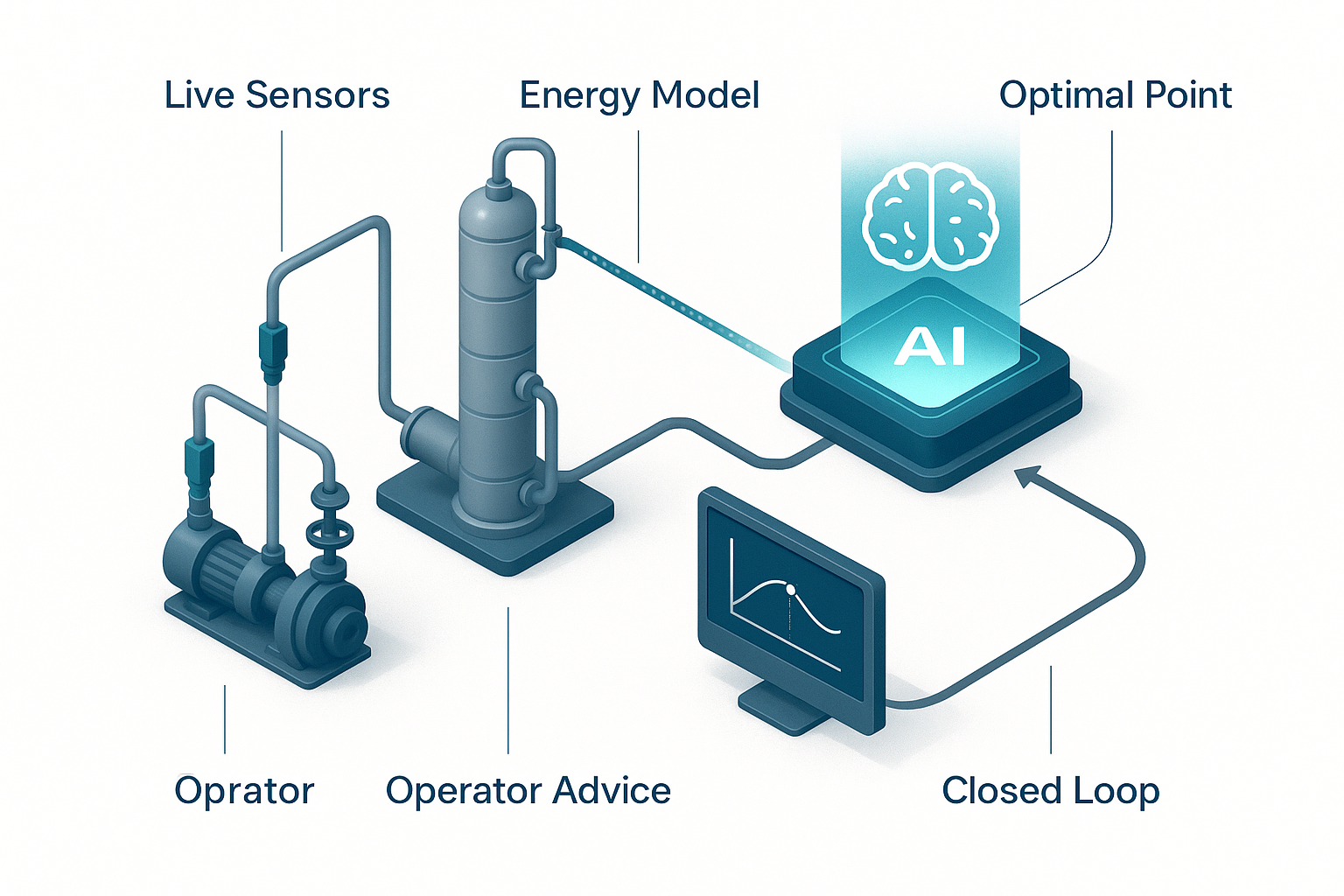
At its core, Energy AI builds a data-driven model of your plant’s energy behaviour and uses it to answer one question over and over: given everything happening right now, what is the most efficient way to hit production targets?
The workflow usually looks like this:
Because PlantPilot already builds a Digital Twin from your existing documentation and P&IDs, the energy model starts with real plant context instead of a blank sheet — it knows which pump feeds which exchanger and where the heat actually goes.
It is useful to separate two jobs. Finding the optimum is an analytical task: crunch historical and live data to identify the best achievable operating point. Holding it is a discipline problem: keeping the plant there shift after shift despite disturbances and human turnover.
Most efficiency programs fail at the holding stage. A consultant finds savings, a report is written, and within months the plant drifts back to old habits. Energy AI is valuable precisely because it never stops watching. It re-finds the optimum every few minutes and nudges the plant back whenever it strays.

The gains are rarely from one dramatic change. They come from many small, continuous corrections:
Typical process plants see single- to low-double-digit percentage reductions in specific energy consumption — enough to move both the operating budget and the emissions ledger.
Energy and carbon are now reporting obligations, not just cost lines. Every kilowatt-hour and cubic metre of gas the plant saves shows up directly in Scope 1 and Scope 2 figures. The same Energy AI data stream that drives efficiency also feeds auditable, time-stamped numbers into ESG and CSRD reports — no spreadsheet reconstruction at year end.
That dual purpose matters. Instead of treating decarbonisation and profitability as competing goals, Energy AI aligns them: the most efficient operating point is usually also the lowest-carbon one. PlantPilot’s energy and CO₂ analytics turn that alignment into a single, continuous source of truth.
You do not need a greenfield plant or a full automation overhaul to begin. A practical path:
This staged approach respects operational reality. Operators stay in command, safety constraints stay sacred, and the AI earns its authority by being right repeatedly.
The optimal operating point is real, valuable — and constantly moving. Finding it once is easy; holding it through every disturbance and every shift is the hard part, and that is exactly where Energy AI earns its keep. By continuously modelling energy behaviour, recommending precise corrections and feeding verified numbers into ESG and CSRD reporting, tools like PlantPilot turn efficiency from an occasional project into a permanent operating habit — lower costs and lower emissions, on the same dashboard.
Get a demo and an individual version of PlantPilot to run your plant operation — saving money, time and emissions. Whether you build plants or operate them: establish a future-ready service business at a fingertip and run your plant smarter.
Get in contact

 Deutsch (DE)