How AI document classification turns messy brownfield plant documentation into a navigable digital twin for maintenance, procurement and ESG reporting.

Every brownfield plant sits on a mountain of documentation: P&IDs, equipment datasheets, loop diagrams, vendor manuals, inspection reports, and decades of as-built markups. The information needed to run the asset safely already exists — it is just trapped in scanned PDFs, network drives, and filing cabinets. AI document classification is the mechanism that unlocks it, turning that archive into a structured, searchable foundation for a digital twin.
Engineers rarely have a data shortage; they have a findability problem. Studies of knowledge work consistently show that professionals lose a meaningful share of the week just locating information. McKinsey’s The Social Economy report estimated that workers spend roughly 1.8 hours per day searching for and gathering information (McKinsey). In a plant, that lost time carries safety and uptime consequences, not just cost.
The scale is daunting. A large process facility can accumulate hundreds of thousands of documents over its lifecycle, and much of it is unstructured. Industry analyses have long estimated that the majority of enterprise data — commonly cited as around 80–90% — is unstructured (IBM). For a plant, that means the drawings and manuals that define your asset are effectively invisible to any system expecting clean, tabular data.

The stakes rise sharply during unplanned downtime, which industry analysts consistently rank among the largest avoidable costs in manufacturing, with maintenance-related failures a leading contributor (Deloitte). When a pump trips at 2 a.m., the difference between a 20-minute fix and a multi-hour outage is often whether the technician can instantly find the correct datasheet and spare-part reference.
Classification is not a single trick — it is a pipeline. Understanding the stages helps you evaluate any vendor honestly.
The result is that unstructured pages become a queryable graph — the foundation of the digital twin our engineering users rely on, because a twin without documents is just a 3D model with no memory.
Full-text search alone fails on plant archives because the same asset appears under different tag conventions, languages, and abbreviations across decades of contractors. Classification adds semantic structure: the system distinguishes a general-arrangement drawing from a single-line diagram, and recognises that “P-101” and “Pump 101” are the same object. That structure is what makes retrieval reliable enough to trust in the field.

Once documents are classified and linked, the twin becomes navigable in a way spreadsheets never allow. A technician selects a valve on the model and immediately sees its datasheet, last inspection, spare parts, and the relevant P&ID region. This is the connective tissue between static engineering data and live operational data from historians such as AVEVA PI System, or via OPC UA from the control system.
That connection is where value compounds:
The World Economic Forum has highlighted that digital transformation in manufacturing — including digital twins and AI — can unlock substantial productivity and sustainability gains across the sector (WEF). The classified document layer is the unglamorous prerequisite that makes those gains real rather than theoretical.
Structured documentation is also the backbone of good asset management under ISO 55000, which treats information as a managed asset in its own right (ISO). Safety cases under IEC 61511 demand traceable records; a classified, linked archive turns audit preparation from weeks of digging into filtered queries.
The same structure pays off for sustainability reporting. Under the EU’s Corporate Sustainability Reporting Directive (CSRD), the European Commission notes the directive substantially expands the number of companies subject to reporting requirements (European Commission). Equipment nameplates, energy datasheets, and refrigerant records extracted during classification can feed GHG Protocol-aligned emissions calculations — connecting engineering data to ESG and CO₂ analytics for plant owners.
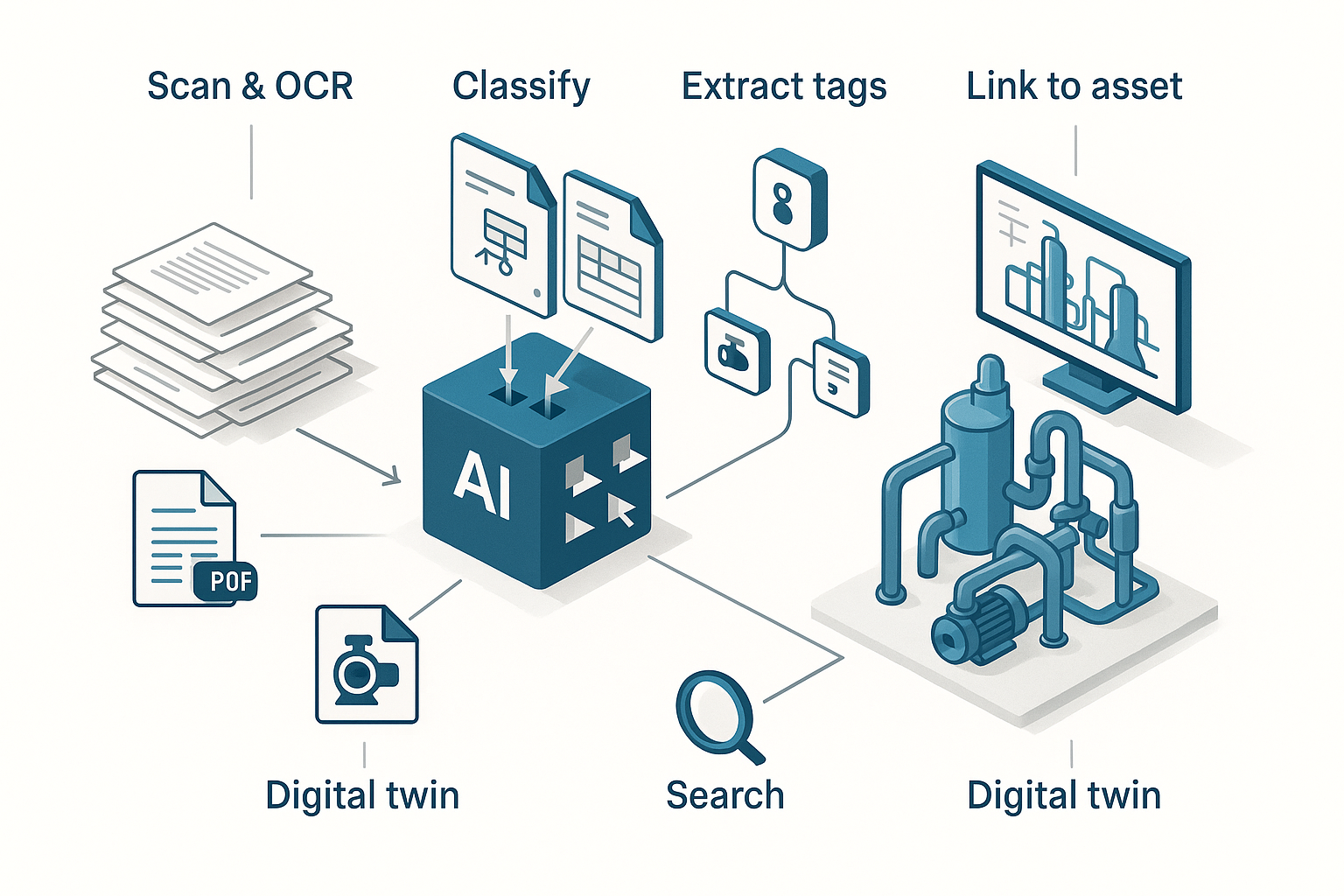
You do not need to boil the ocean. A defensible sequence:
No pipeline is perfect. Poor-quality scans reduce OCR accuracy, and inconsistent historical tag conventions require mapping rules. Budget for a data-quality remediation phase and treat classification confidence scores as a first-class metric. The goal is not 100% automation on day one; it is a steadily improving, trustworthy index of your plant’s memory.
Brownfield plants are not short on knowledge — they are short on access. AI document classification is the practical bridge from paper-era archives to a living digital twin: it reads, sorts, and links your documentation so every asset carries its own history. That single capability shortens outages, accelerates procurement, strengthens ISO 55000 and IEC 61511 compliance, and feeds CSRD-grade ESG reporting. Start narrow, keep humans in the loop, and let the classified document layer become the foundation everything else is built on. See how PlantPilot approaches this.
Get a demo and an individual version of PlantPilot to run your plant operation — saving money, time and emissions. Whether you build plants or operate them: establish a future-ready service business at a fingertip and run your plant smarter.
Get in contact

 Deutsch (DE)